There Are No Straight Lines
Curated by Amber Koroluk-Stephenson
Poimena Gallery, kanamaluka/Launceston
21 August - 18 September 2025
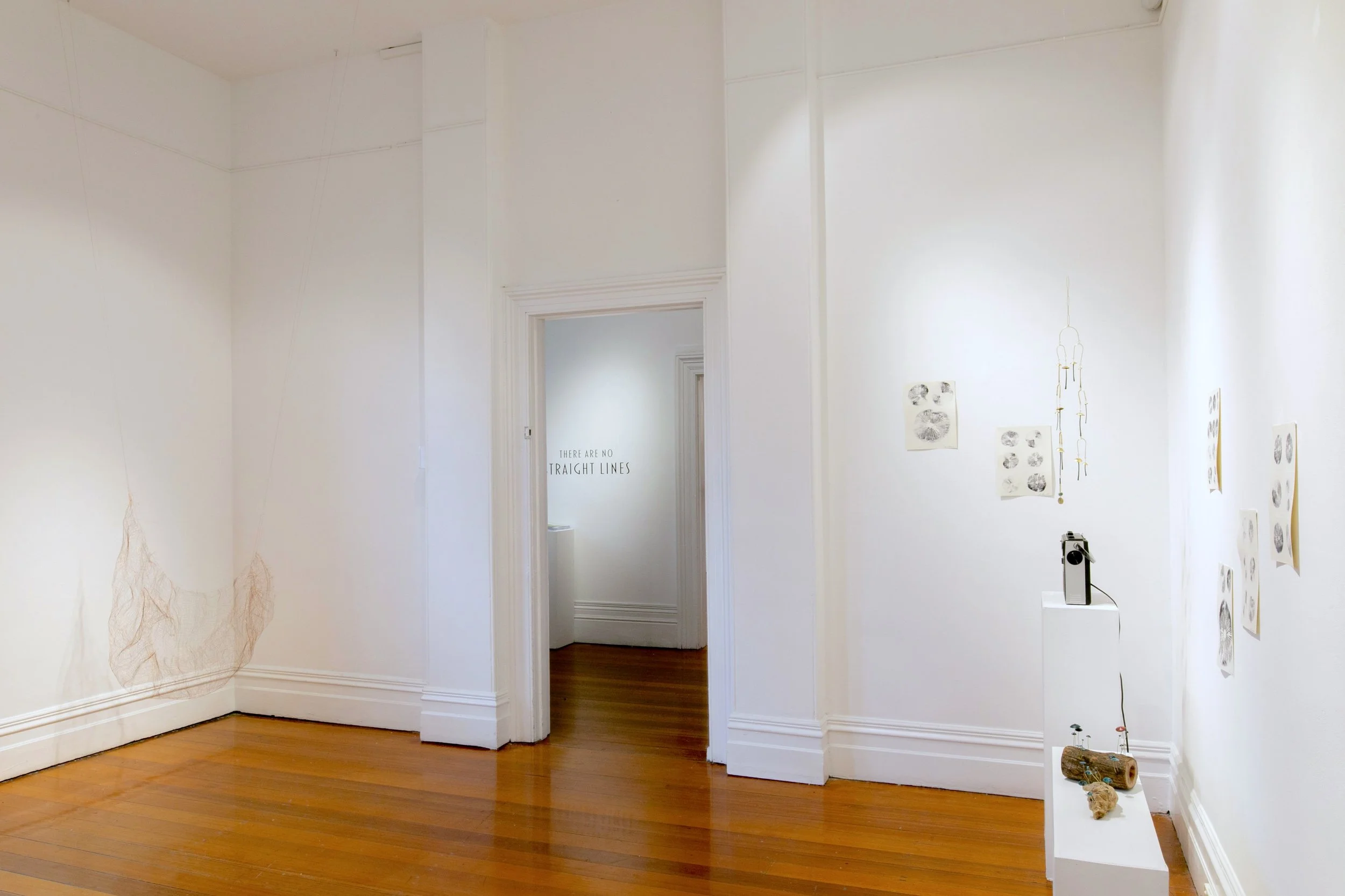

There Are No Straight Lines
Emma Bugg
Alicia King
Eloise Kirk
Amber Koroluk-Stephenson
Sara Morawetz
Cassie Sullivan
Jodie Whalen
There Are No Straight Lines reconsiders constructed notions of time as being linear, instead looking towards notions of circular time that is considered to be repetitive, familiar, and continuous. This exhibition is a mediation of what it means to think about the contrasting effects between deep time and the present moment. Indeterminate spaces where beginnings and endings loop, continually forming in the middle. Time never ended, it never started.
In a complex web of the infinite, time is marked by repetition. The sun rises and sets, seasons change, planets and solar systems orbit, and living things go through the biological cycle of birth, life, death. The cyclic nature of time space blurs boundaries between memory and systems of knowledge, between fact and fiction, being and not being, between self and other, the here and now, the now and then. In this setting, time and space are experienced and understood in multiple ways, paving out a rich tapestry for capturing the minute and monumental, the everyday and the sublime.
Photography by Cassie Sullivan
Catalog essay: There Are No Straight Lines
Written by Jade Irvine, August 2025
Curated by Amber Koroluk-Stephenson, There Are No Straight Lines presents works which critically consider our conceptions of time – of common occurrences such as life and its synchronicities: of emotion, history, being as certain as the gradual slippage of night into day.
Sahil Prasad, a seventh grader from Maryland, writes, “the concept of nothing going in a straight line can be associated with life as much as it relates to science and architecture ... life is a curvy path full of unexpected twists, turns, and adventures that nobody can ever predict.”[1] The topic is a source of interest for students, scientists, philosophers, architects and artists alike.
For Plato, a fundamental element of a work of art is the way it was created, and the perspective it considers. He writes, “because you’ve seen the truth about the fine, just, and good things, you’ll know each image for what it is and also that of which it is the image.”[2] Art reflects life, and life reflects the infinite – straight lines in nature are seen as an illusion. They are one way for us to make sense of life’s complexity. To make art is to bring these unpredictable forces into being, and to give space to these ambiguities and contradictions.
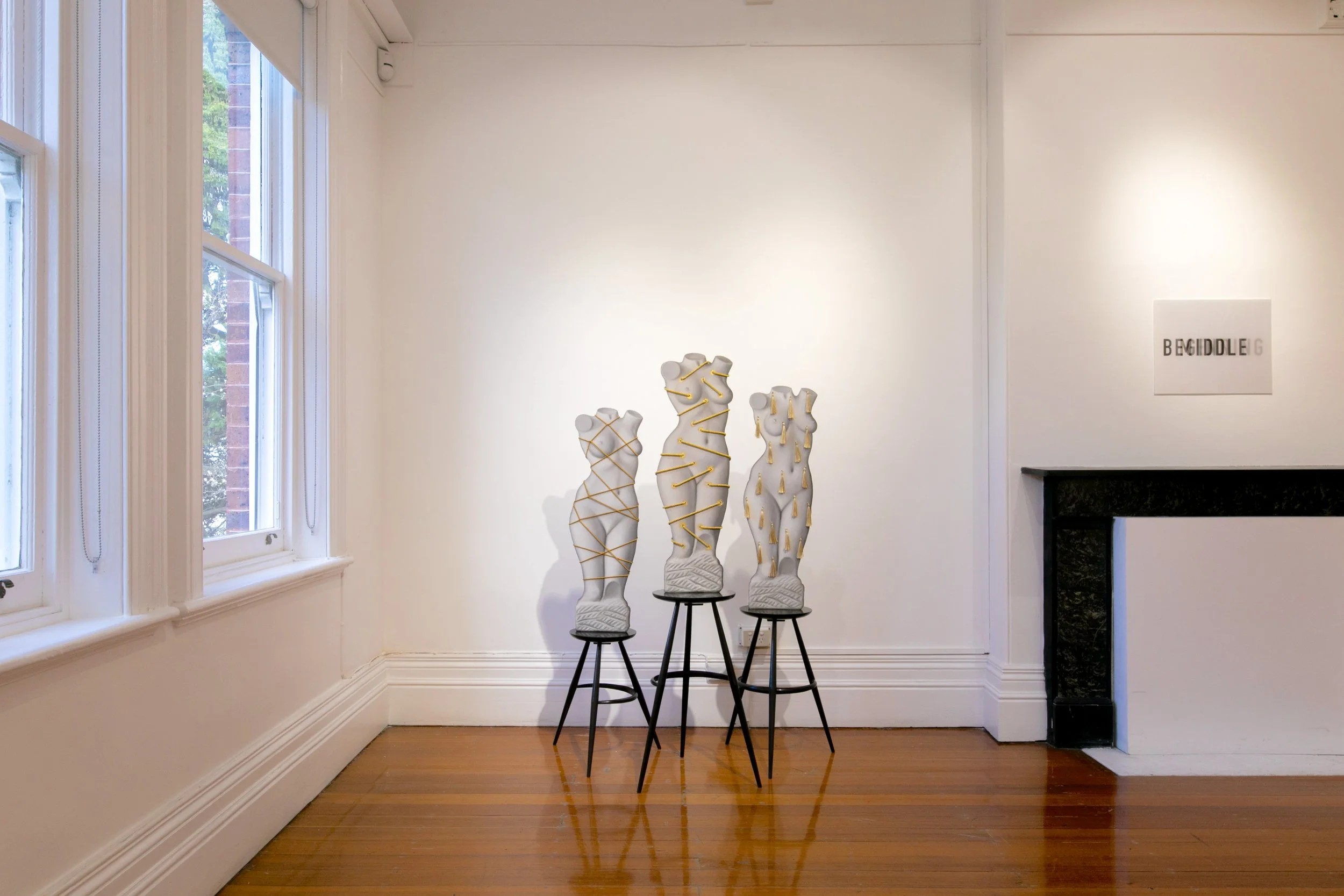
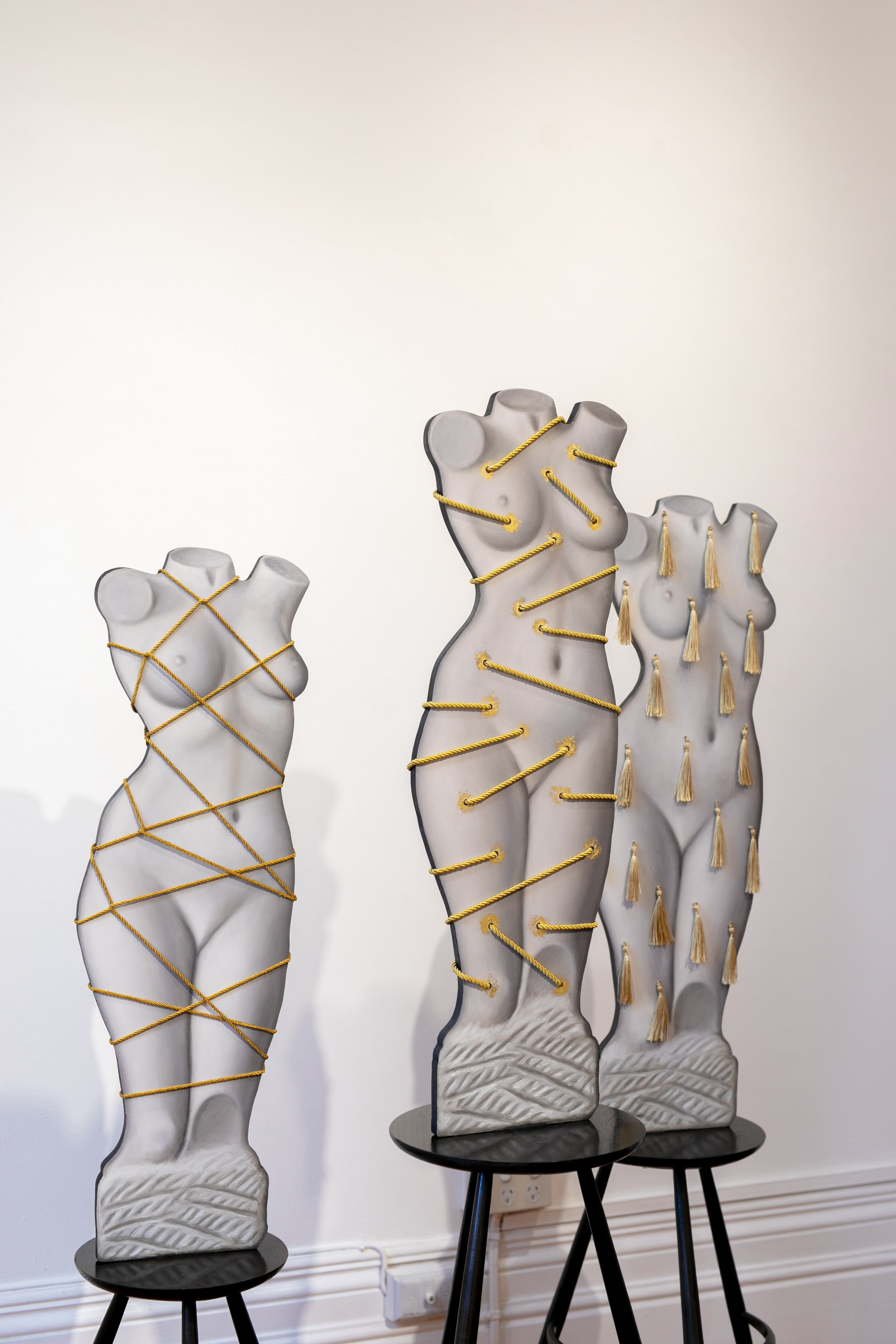
For this exhibition, Koroluk-Stephenson has reimagined Rayner Hoff’s 1927 sculpture, Australian Venus in her work, Threads of Fate. Referencing Classical European beauty and mythology, Koroluk-Stephenson questions what it means to carve out an Australian identity bound by a historical gaze that is unnerving and socially policed. The work is situated within patriarchal notions of femininity and morality that persist today.
Emerging technologies have increasingly provided a strong tactile and narrative grounding to Emma Bugg’s object-based and wearable works. On this occasion, Bugg has incorporated fungal spores to make a future relic – a mycelium network of storied connectivity.
Alicia King’s sculptural work connects us to the speculative wonder of time spent living within large ecosystems. In thinking about minerality and extraction – who owns the future, and what is our responsibility to each other and to other beings?
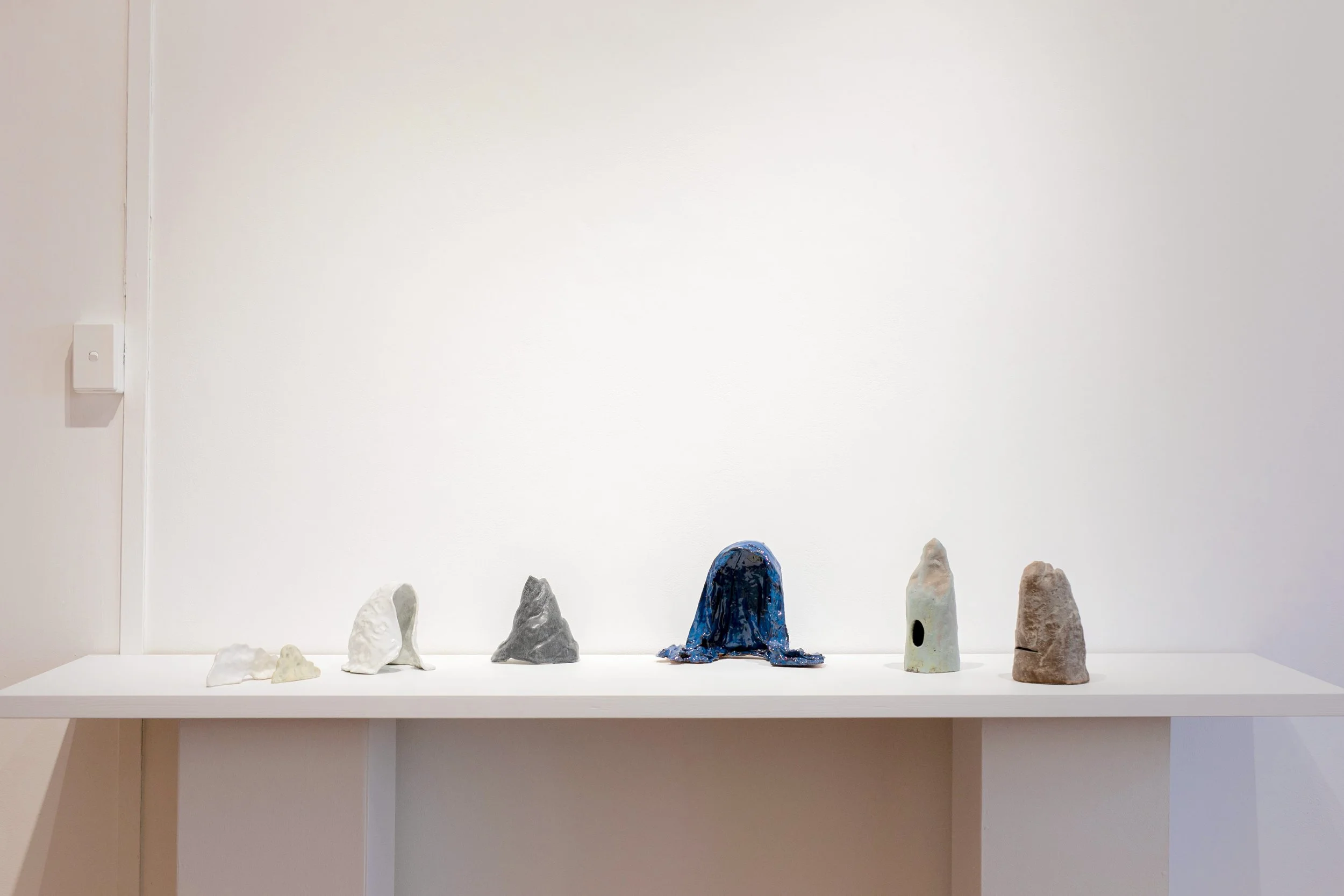
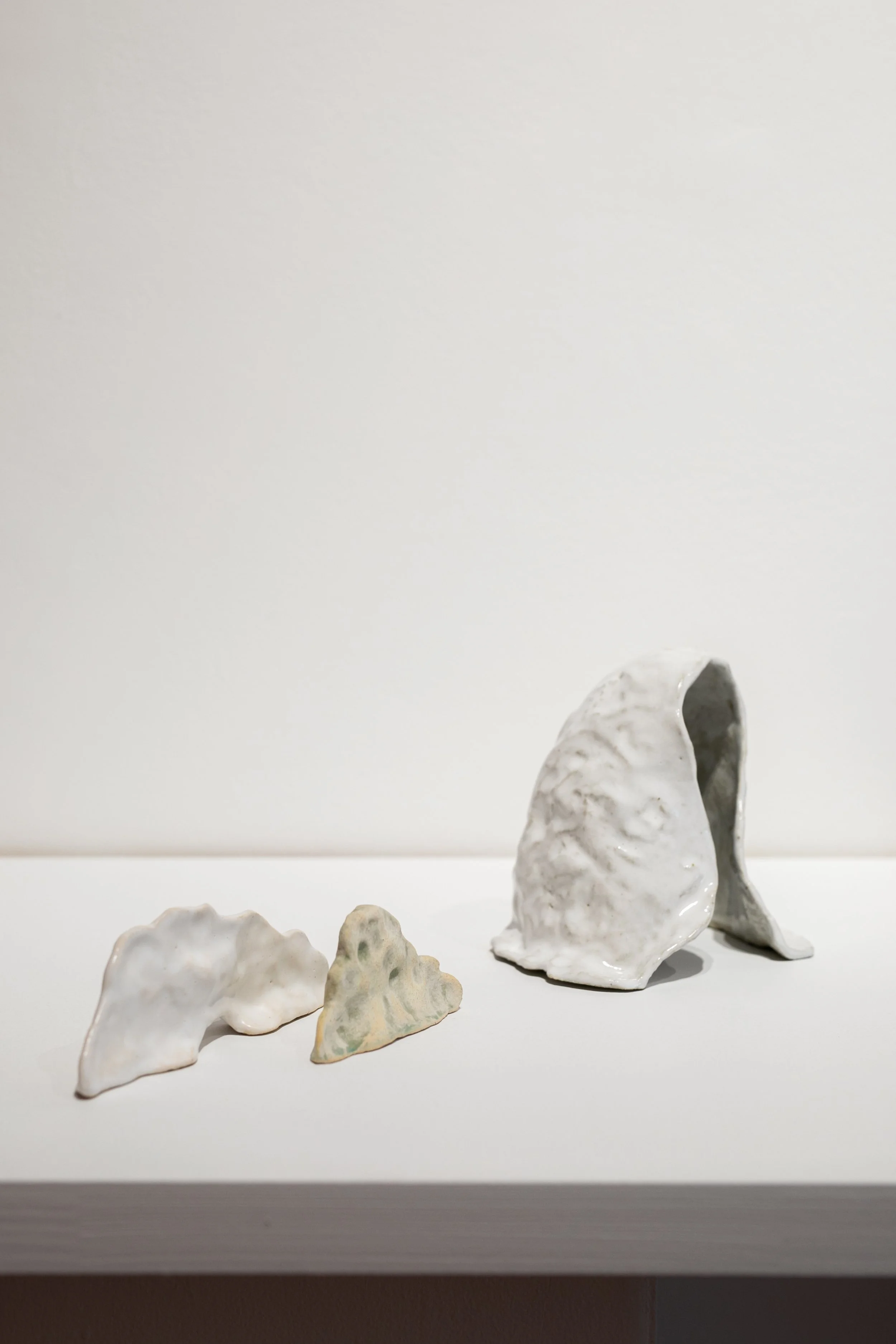
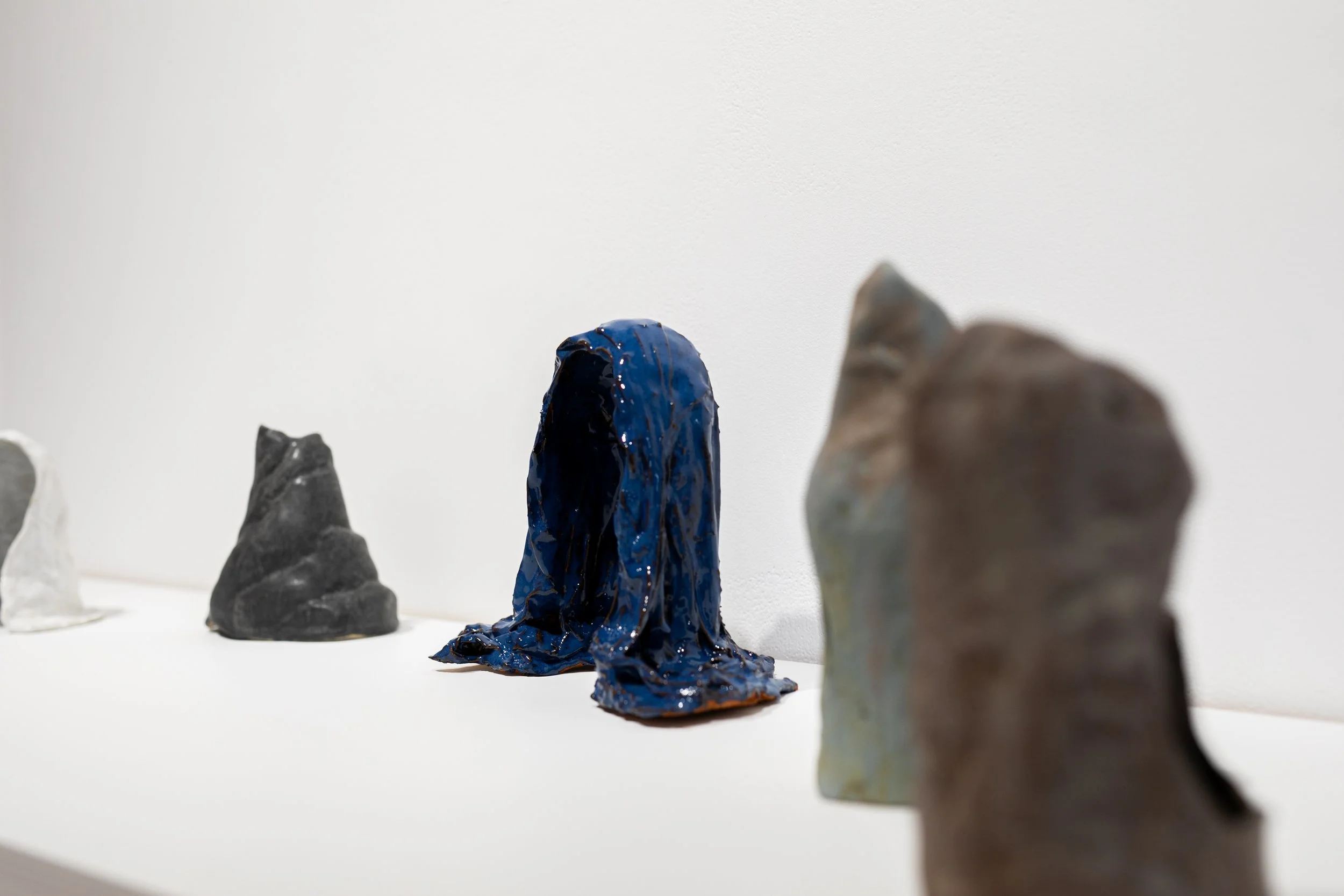
In a contrasting approach, the fluidity of Eloise Kirk’s sculptural works suggests the presence of clouds and rich geological formations. They speak to what has always been, and the symbols that are prescient within our society and within our psyches.
How do you incorporate the strands of time in all its complexity? Cassie Sullivan’s multi-disciplinary work offers an embodied response to being on Country through a First Nation’s perspective of belonging. Sullivan’s work is deeply interwoven with feelings of being rooted in place, while in a continuous process of becoming.
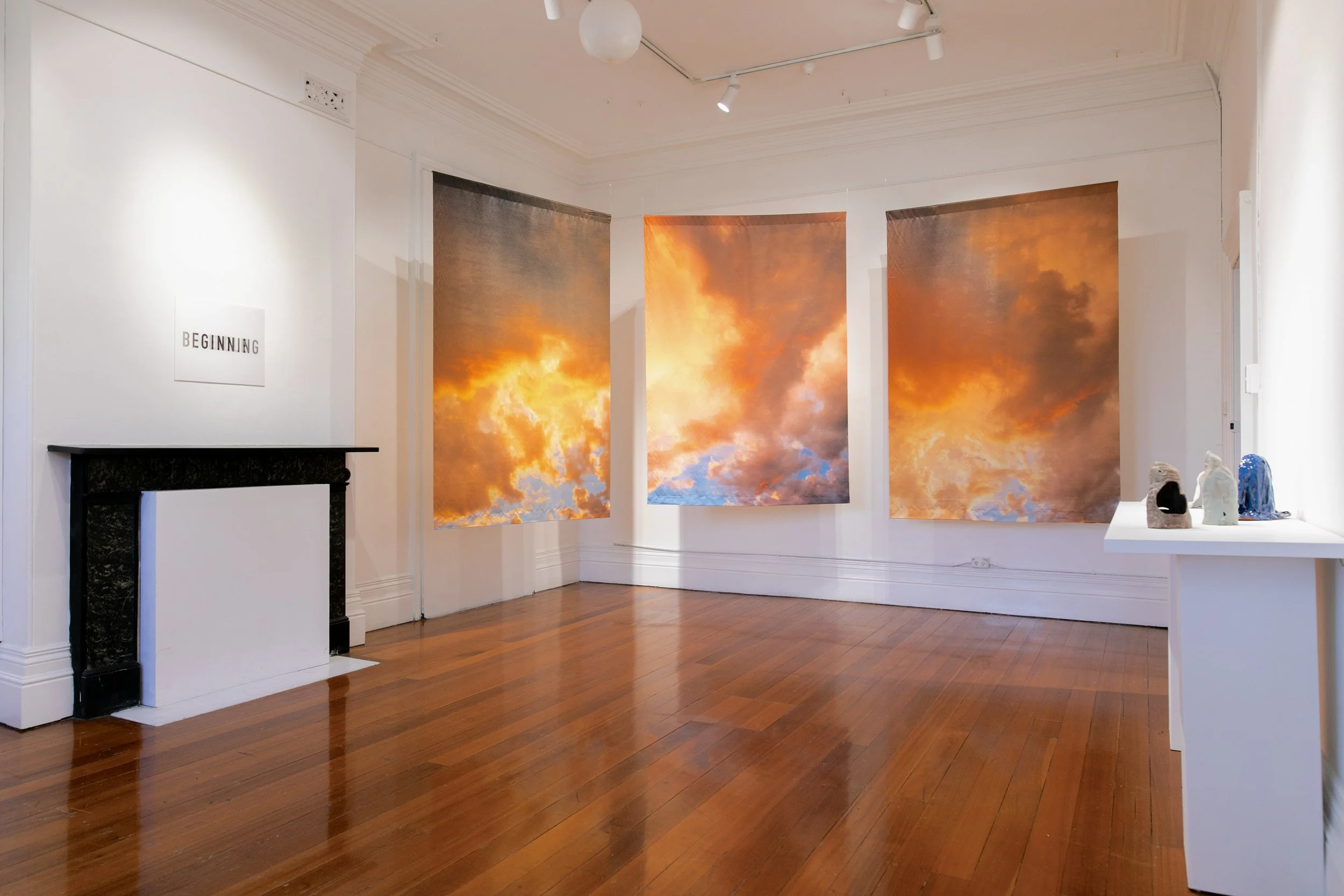
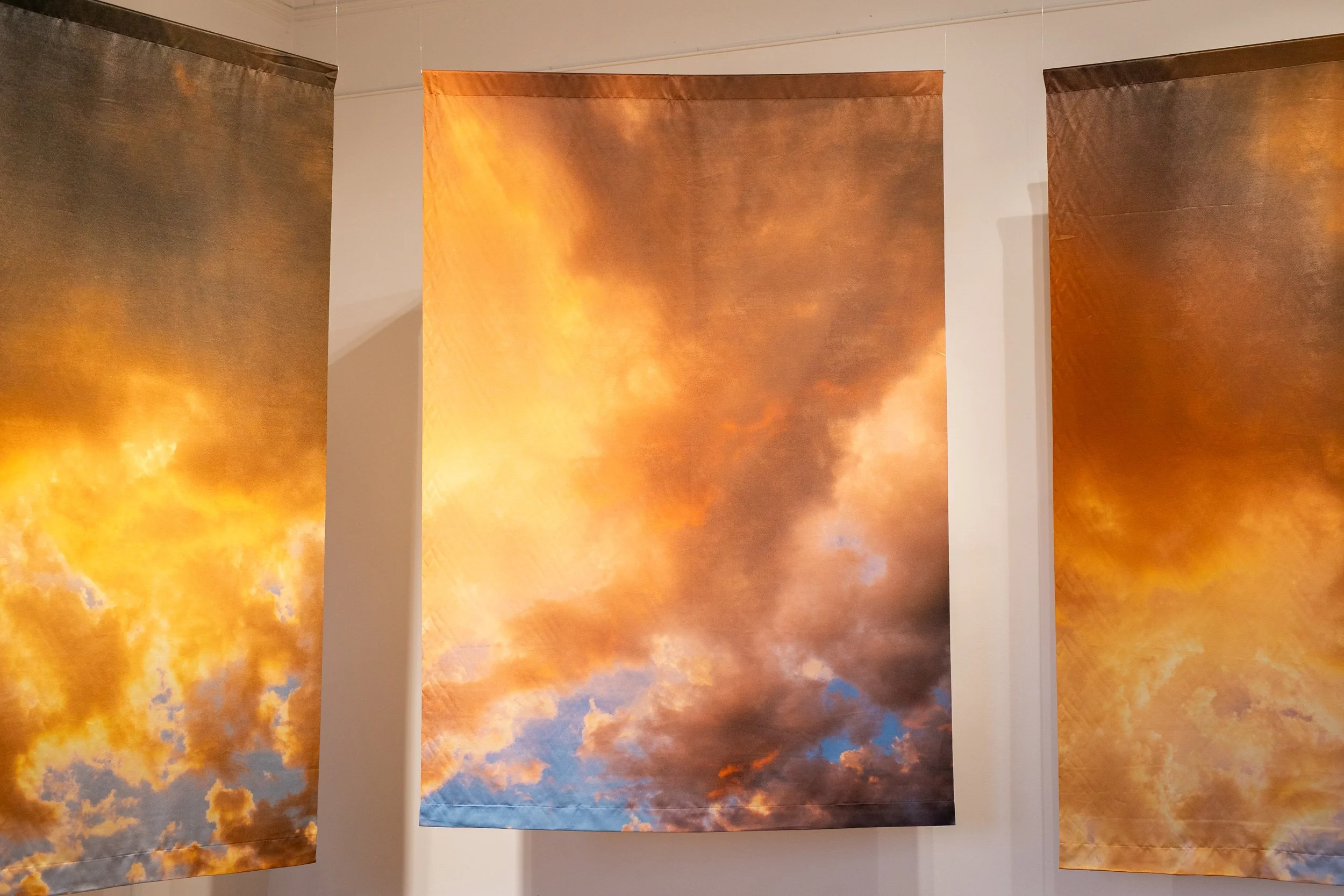
Repetition as a process is also integral to Jodie Whalen’s ways of working. Whalen’s digital prints on fabric underscores the ritualistic process of artmaking, and with a fractal appreciation of the sublime.
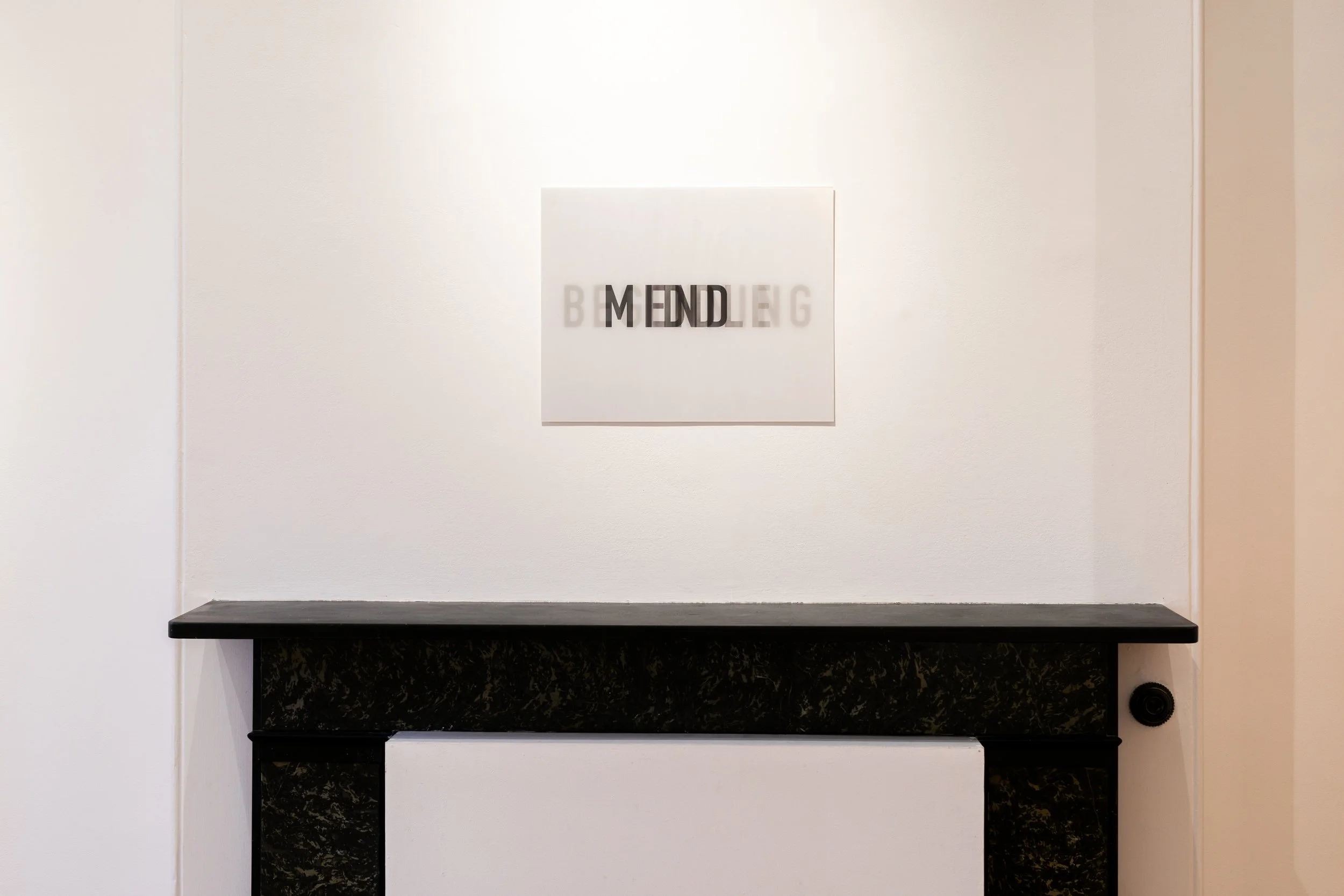
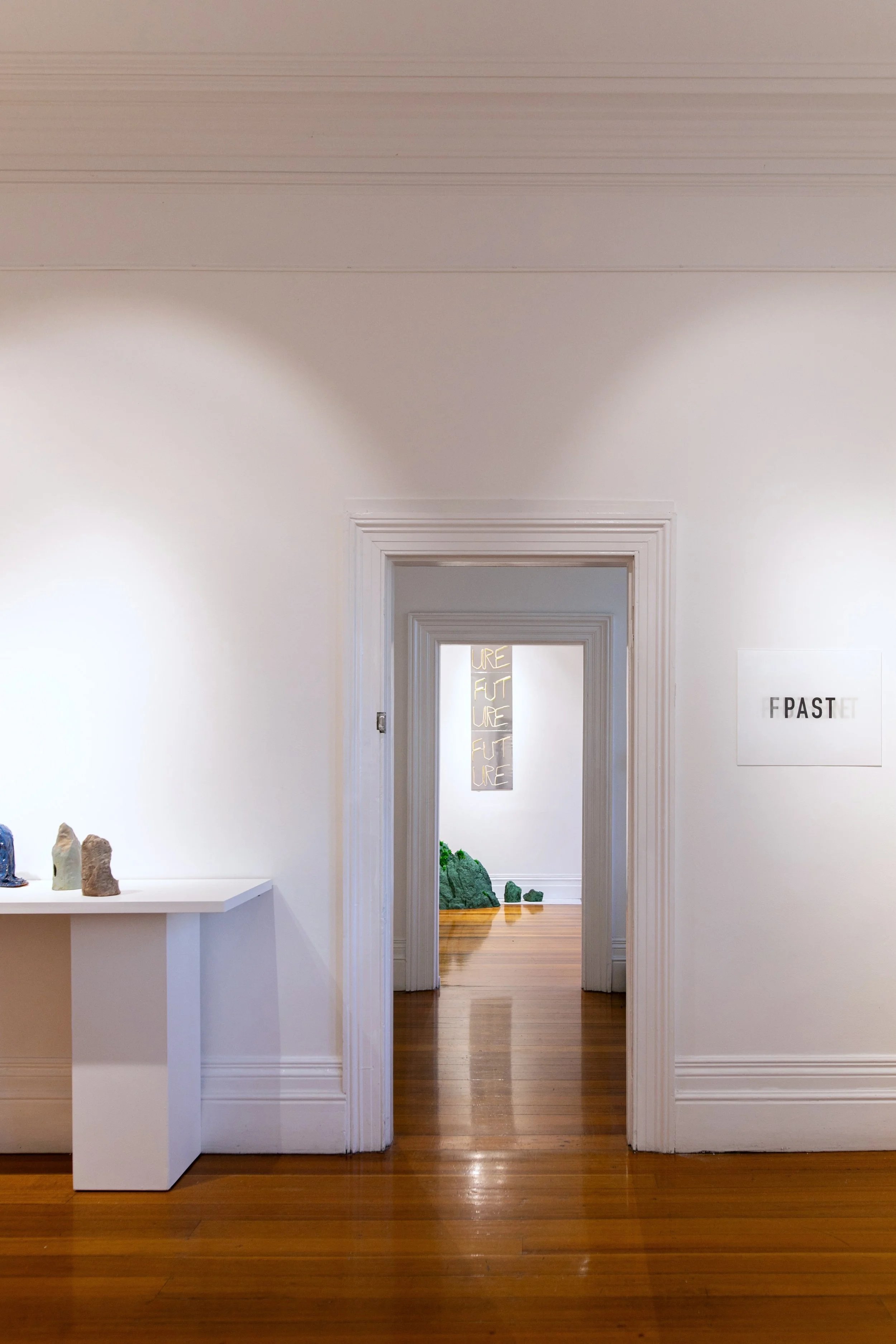
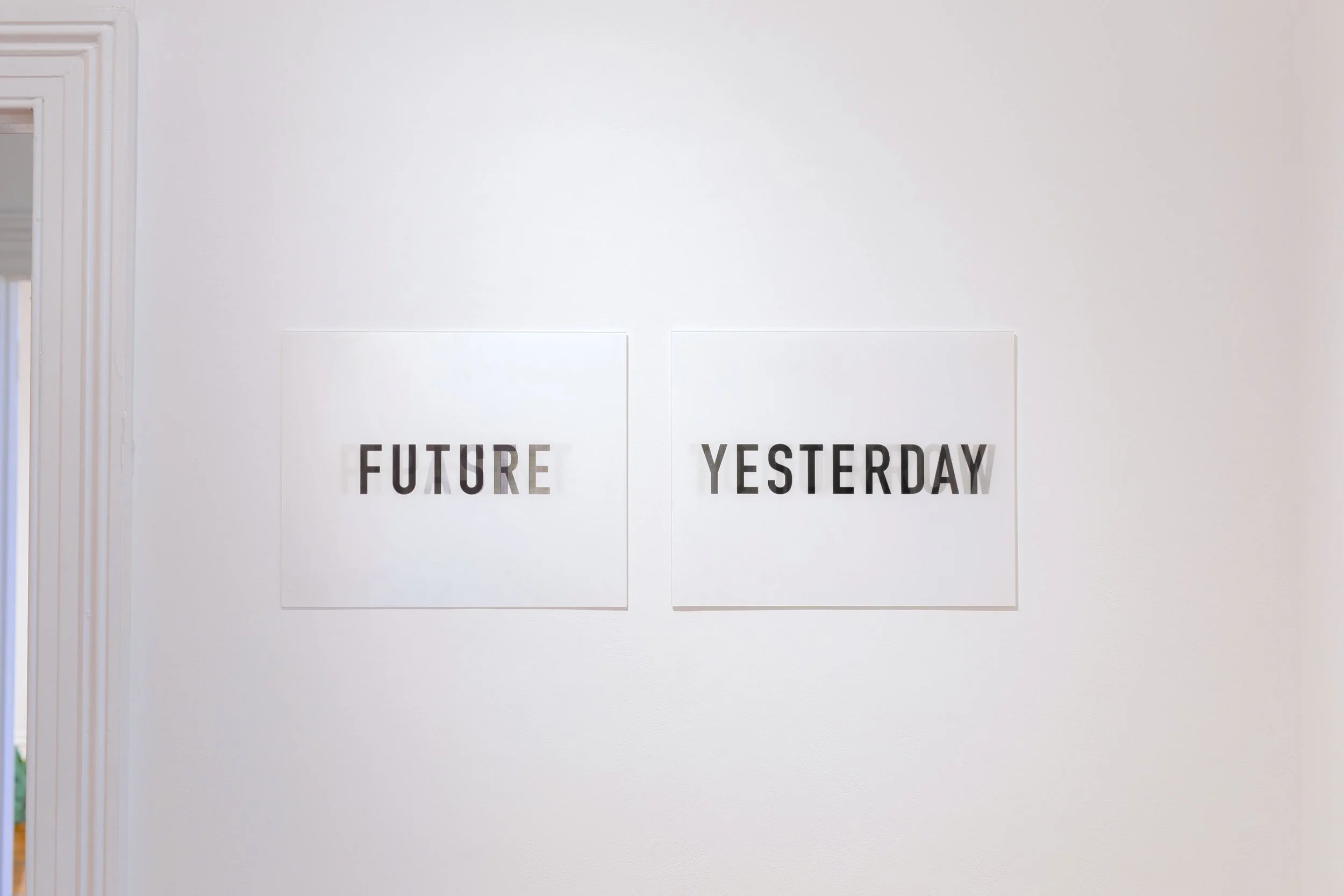
Tenses, by Sara Morawetz is a study of lexical ambiguity which playfully distorts or re-envisions the ambiguity of multiple perspectives through text. This prompts us to consider your proximity, an awareness of your physical positioning in space. Responding to Koroluk-Stephenson’s curatorial thesis, when does the present become the past? When does today end and tomorrow begin? How are these questions guided by pre-existing structures which do not serve a future of generosity?
Art can shape our futures, making conscious our realities and rethinking the systems that take us away from real work. Who are we to argue with reality?
[1] Sahil Prasad, ‘A Straight Line: Simply Nonexistent’, Skipping Stones: A Multicultural Magazine, 2023, viewed on 3 August 2025, https://www.skippingstones.org/wp/2023/05/09/a-straight-line-simply-nonexistent/
[2] Jeremy Killian, ‘That Deceptive Line: Plato, Linear Perspective, Visual Perception, and Tragedy’, The Journal of Aesthetic Education, Vol. 46, No. 2 (Summer 2012), pp. 89-99 Published by: University of Illinois Press, https://www.jstor.org/stable/10.5406/jaesteduc.46.2.0089
Emma Bugg
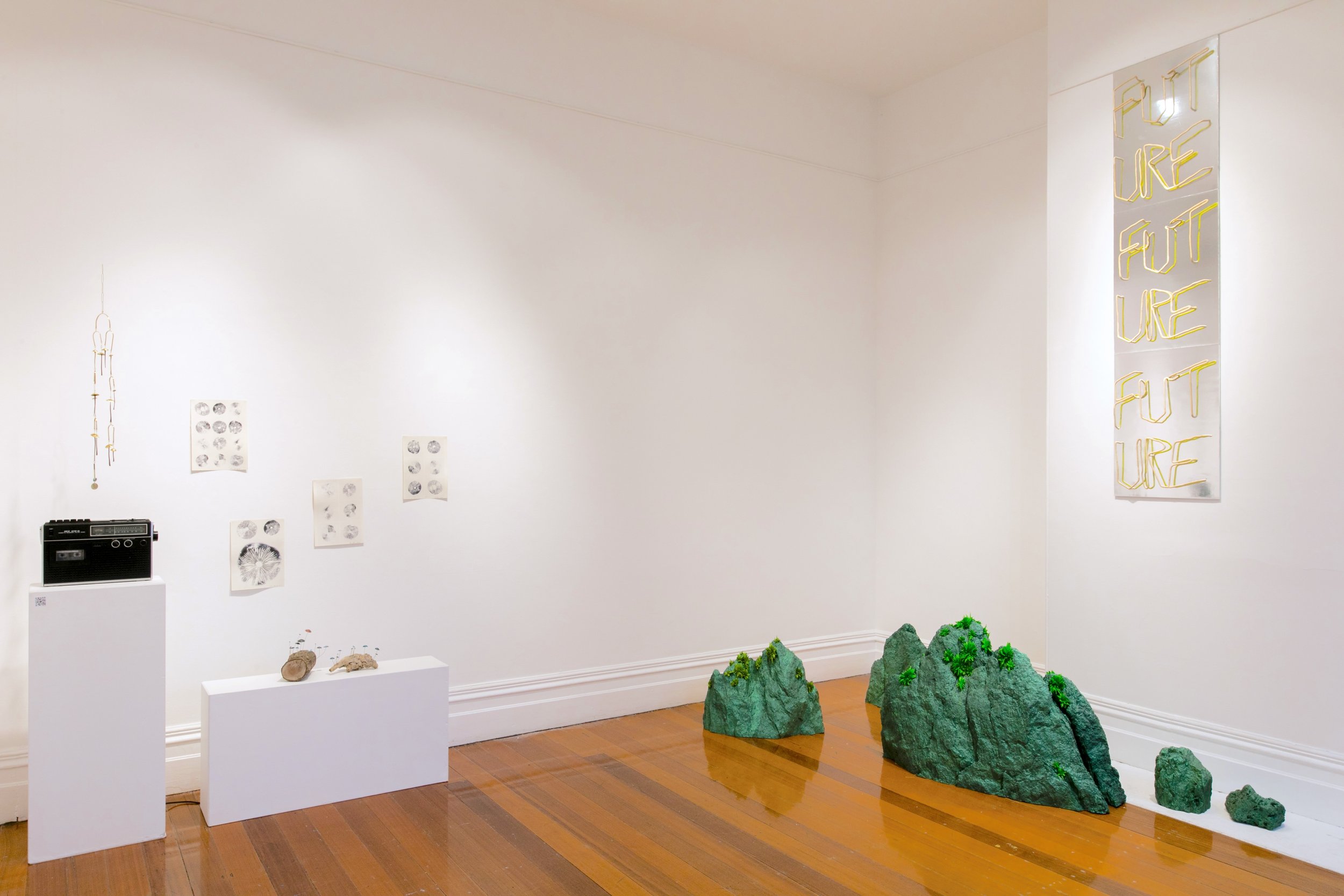
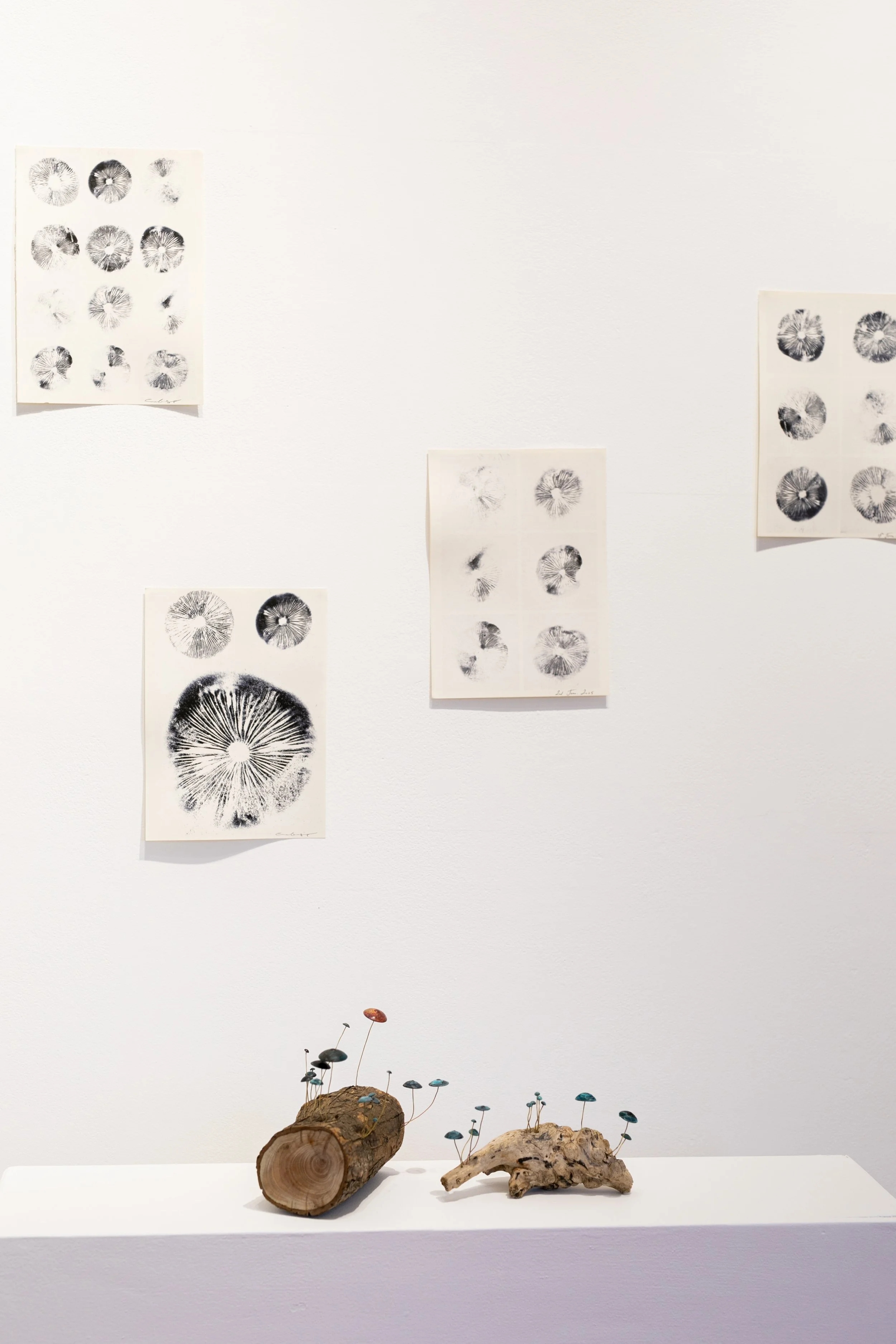
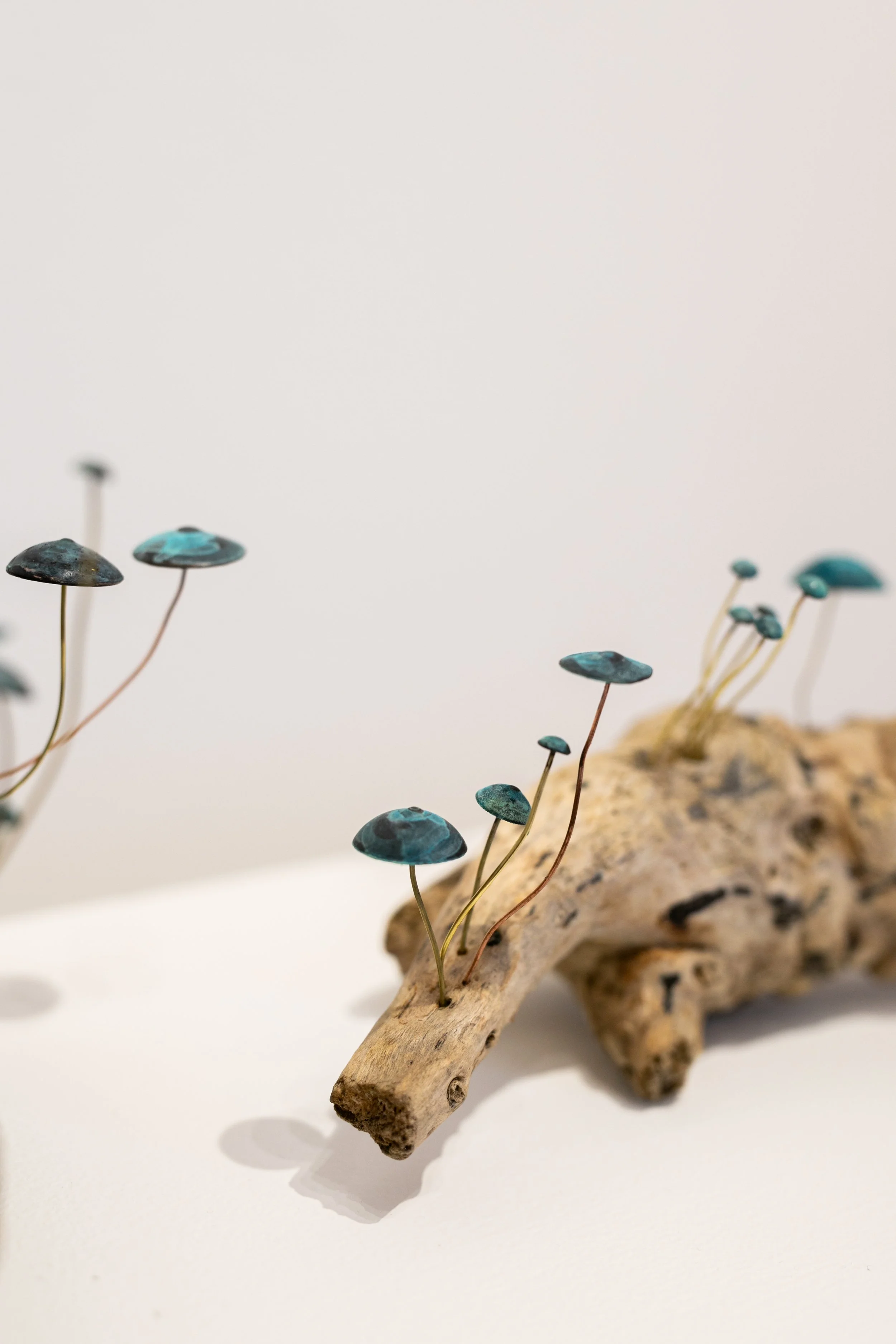
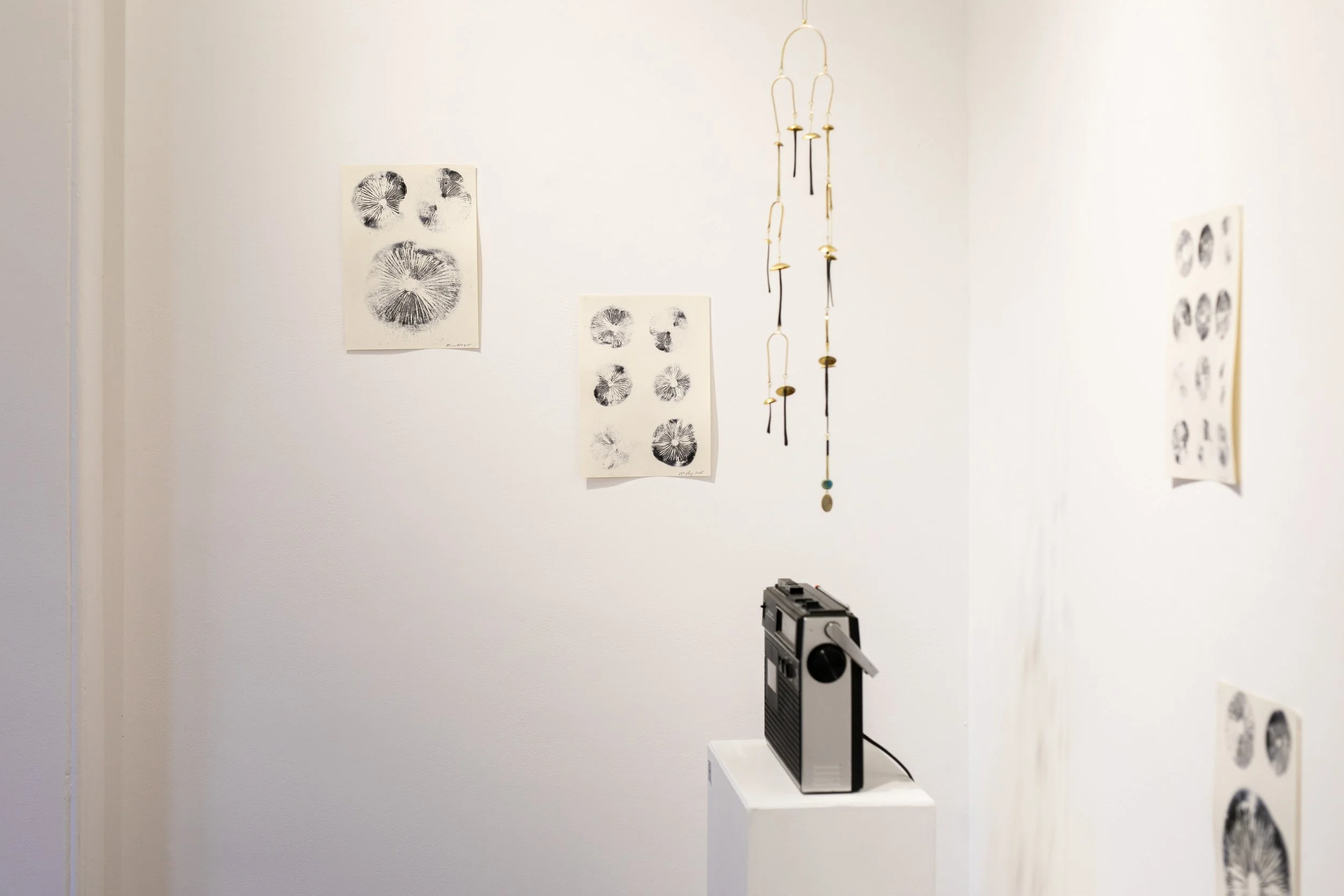
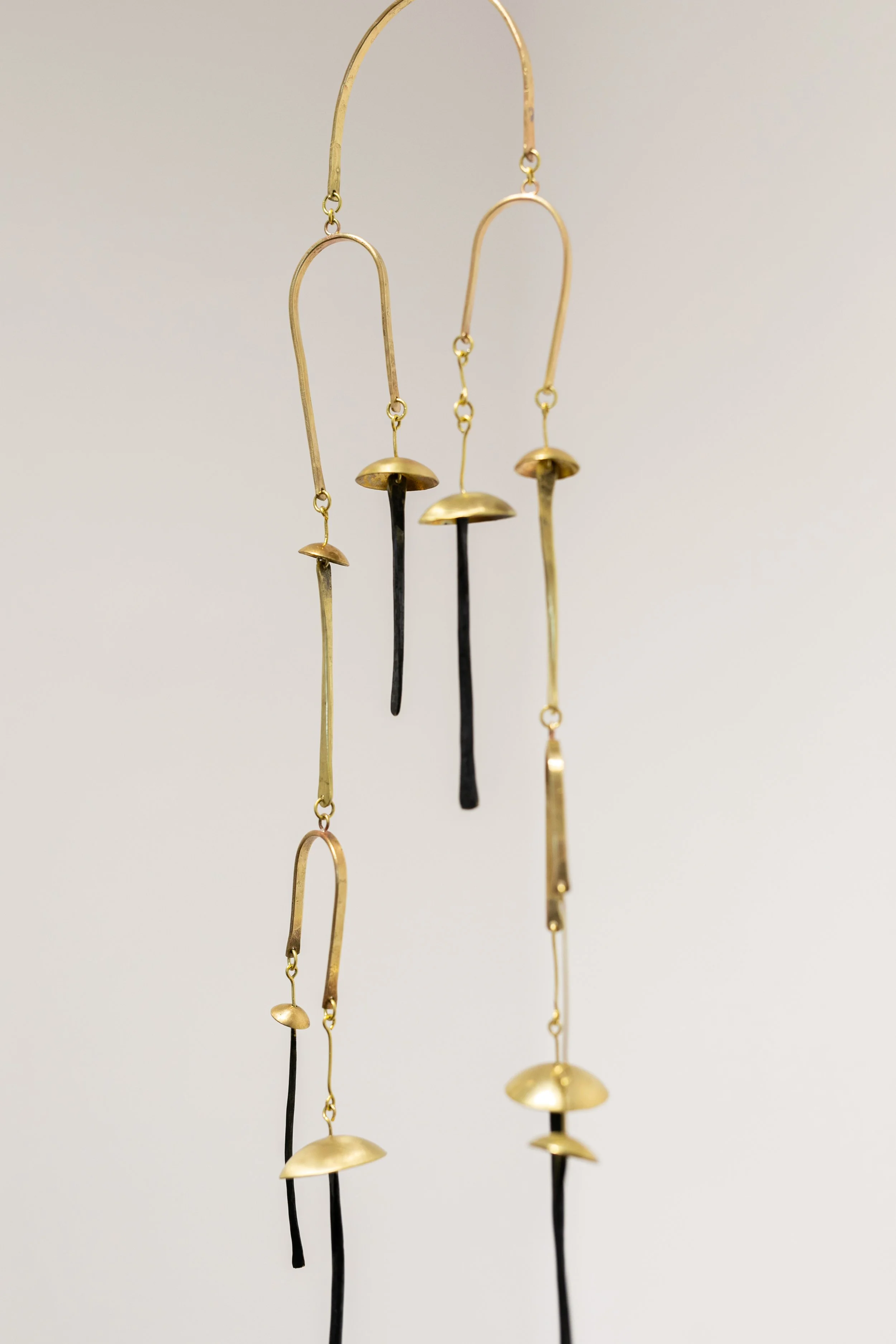
Underground Chorus, 2025, copper, brass, foraged wood, stereo, cassette tape, mushroom spore print prints on paper, digital content
Underground Chorus draws on fungi as both material and metaphor, using sound, sculpture, and digital layers to explore non-linear time, memory, and connection. Emma Bugg translates her jewellery-making skills into more sculptural forms, creating hand-forged brass mushroom chimes suspended above an analogue cassette recorder. Visitors are invited to contribute a breath, tone, or hum, recorded anonymously on tape as raw material for future iterations.
Copper mushrooms emerge from wood, shaped and patinated through alchemical processes of transformation. Spore prints, collected from Tasmanian fungi are enlarged and printed to reveal invisible cycles of dispersal.
A QR code links to a dedicated digital space (emmabugg.com/underground-chorus), where a quiet narration deepens the audience experience. Created forThere Are No Straight Lines, this work resists resolution, growing gently, like fungi, in many directions.
Alicia King
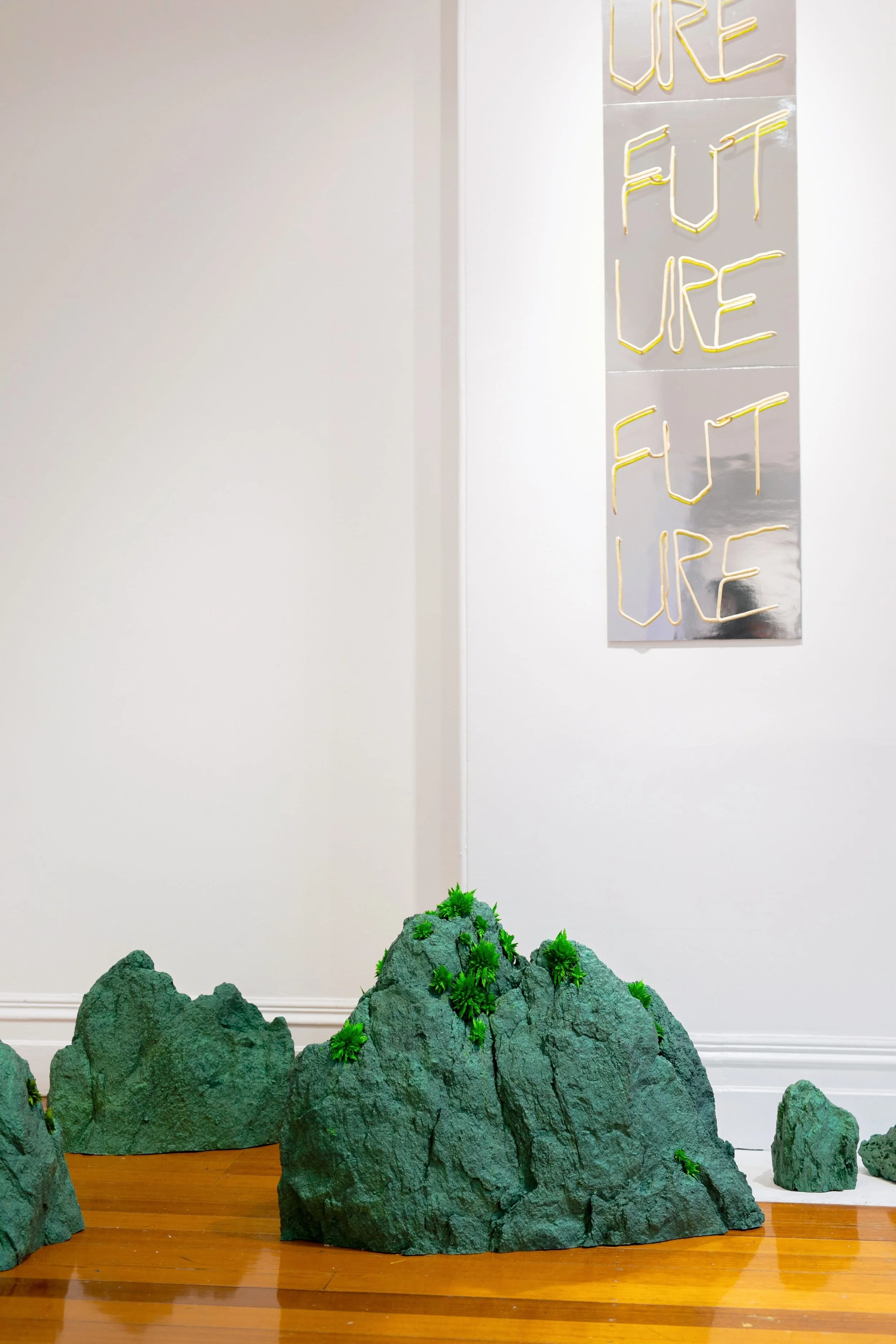
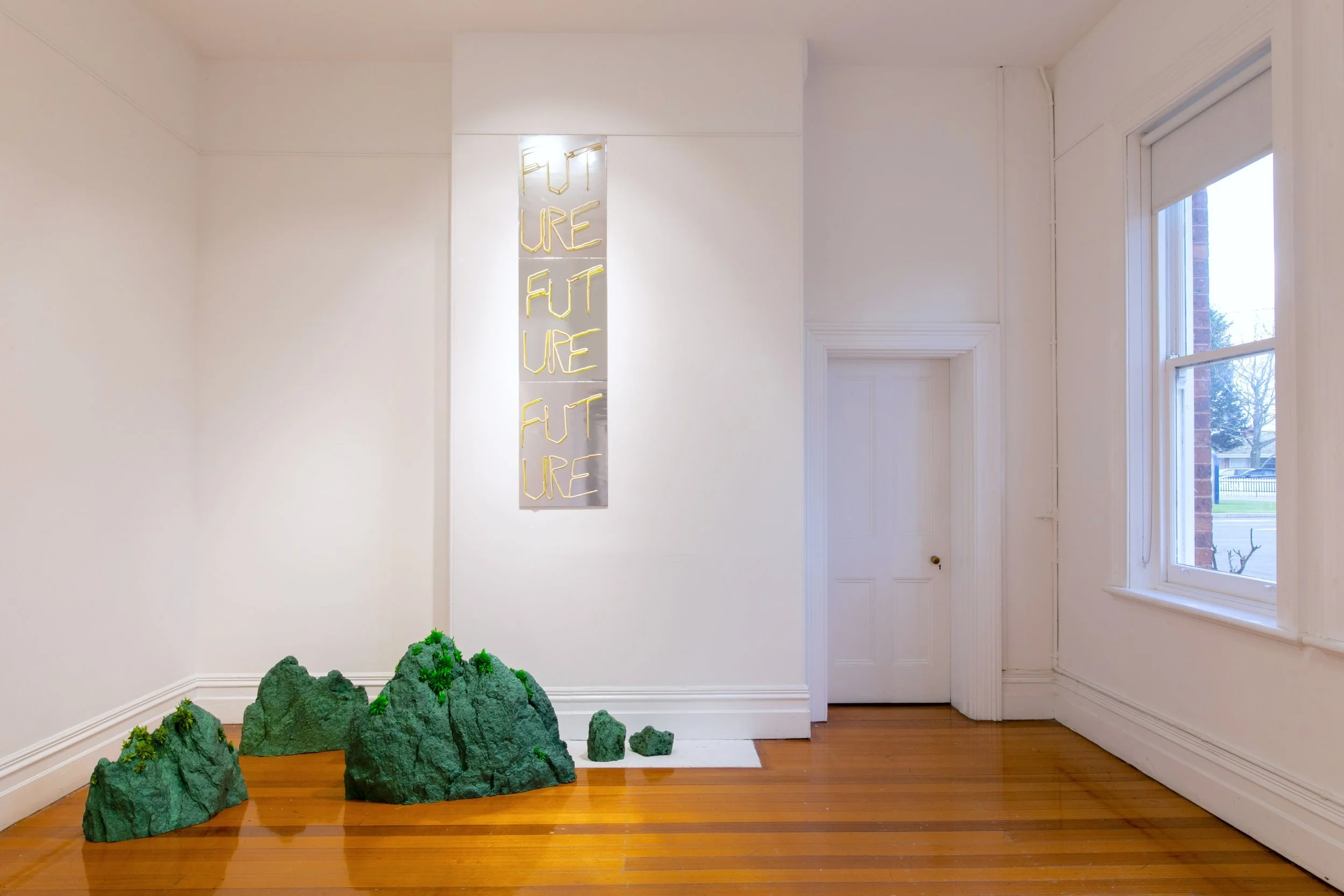
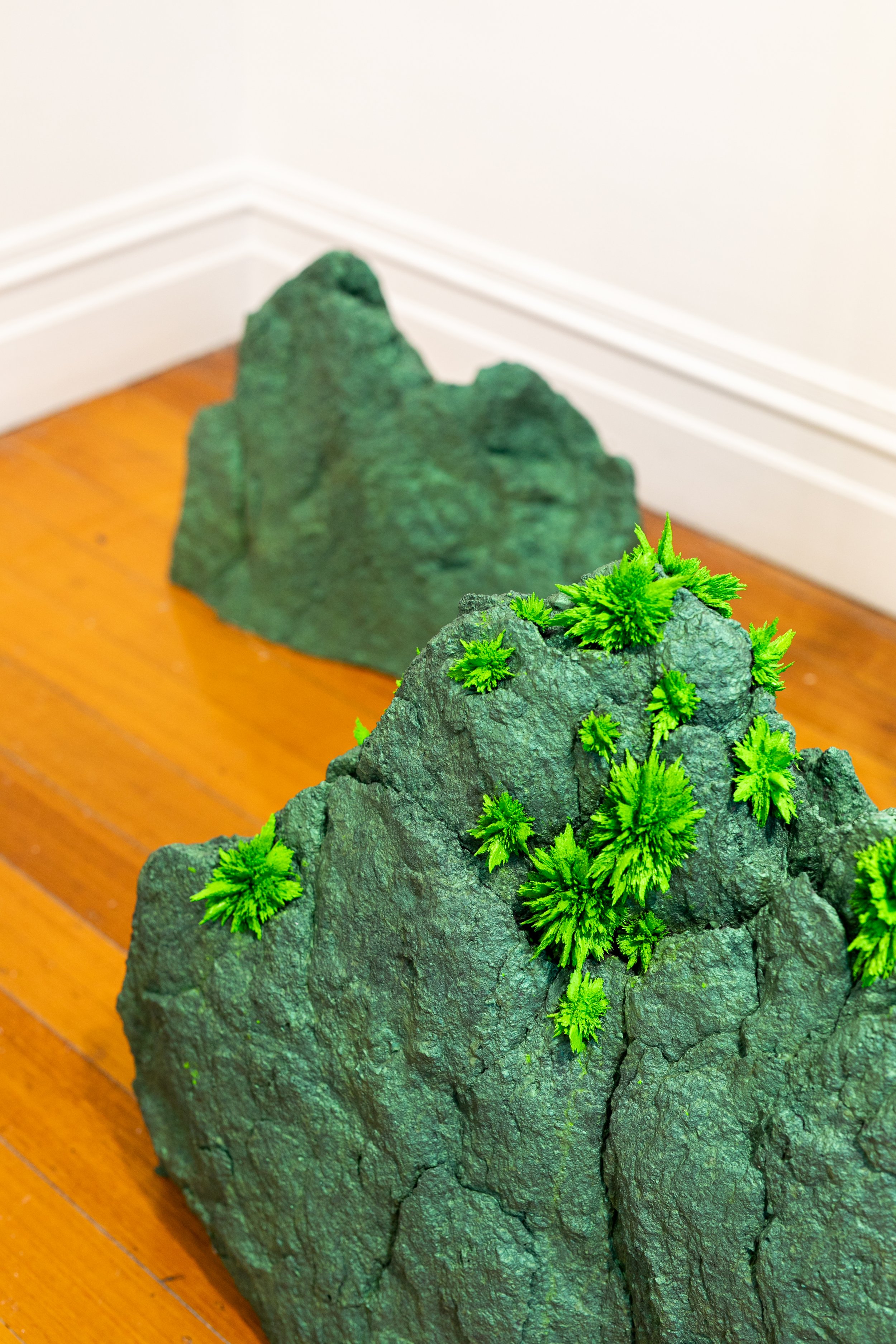
The future is always the future is always the future, 2025, Balsa wood, iron, synthetic polymers, mineral pigments
In this artwork, delicate hand-carved balsa wood imitates neon text, while a synthetic mirrored surface channels the lustre of industrial, polished metal.
Below, volcanic rocks, symbols of deep evolutionary time, replicated in synthetic polymers, silently shimmer. Across their surface, tactile crystalline forms emerge.
These materials collectively imply a mirage - a mythology of the future - the human-made utopia that is always approaching yet never arrives. The future is always the future is always the future…
Eloise Kirk
A meeting of spirits, 2025, glazed stoneware
Eloise’s work explores the unification of sculpture collage and installation, sampling images of geological formations, waves and clouds. Using erasure, fragmentation and assemblage, Eloise creates sequences of symbolic arrangements. The work is explicitly elemental, offering an aesthetic response to the juncture between natural beauty and fragility that tests boundaries between the romantic and the surreal.
Amber Koroluk-Stephenson
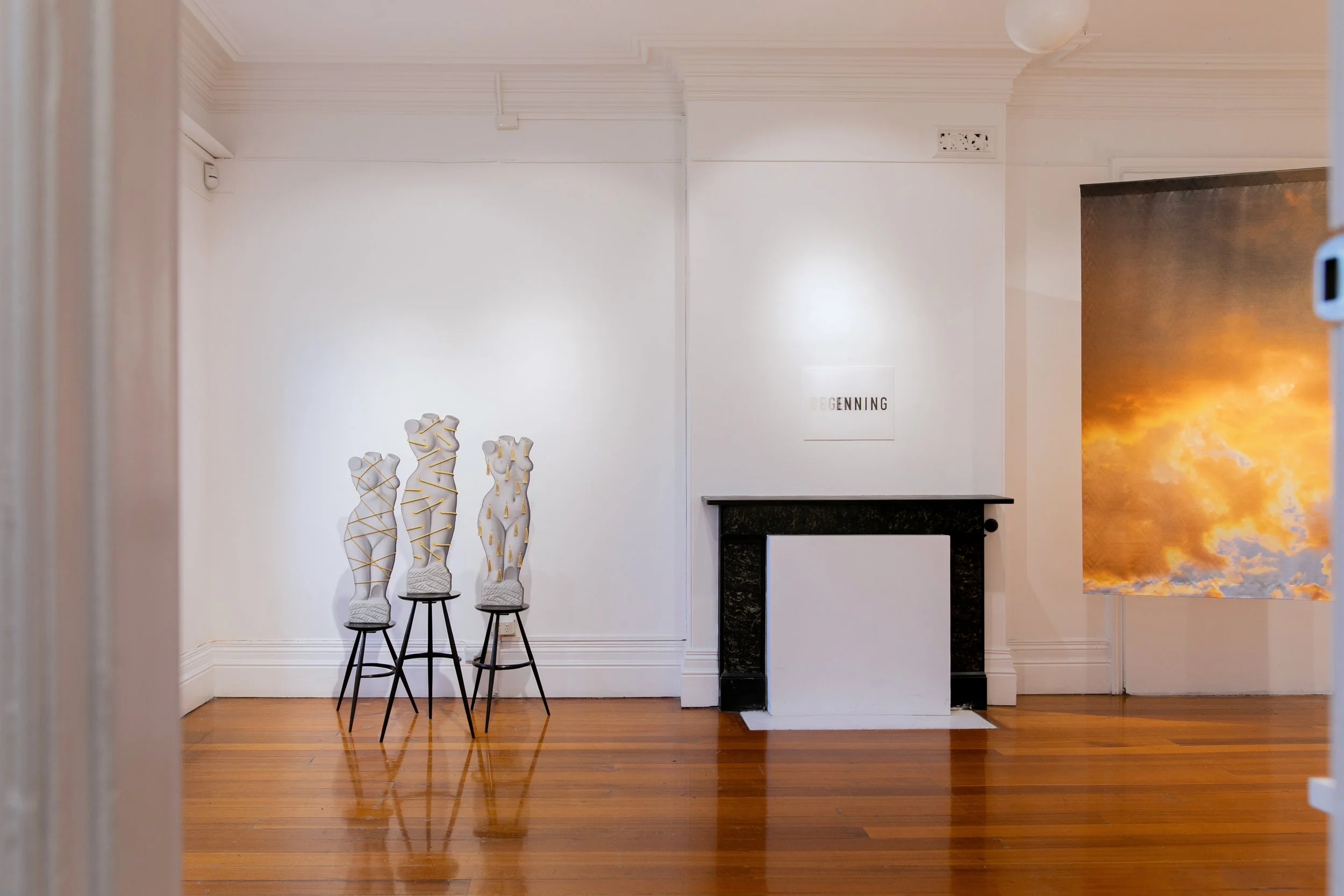
Threads of Fate (Australian Venus, after Rayner Hoff), 2025, oil and gold leaf on ebonised marine birch plywood, gold nylon rope and tassels, brass nails, stained Blackwood stands made by Benjamin Grieve-Johnson of Other Furniture
Is fate a fixed path or a tapestry woven with choices and consequences?
Threads of Fate reimagines Rayner Hoff's 1927 sculpture, Australian Venus, critiquing artificial constructs of femininity that have been perpetuated through European art histories. Drawing of European mythologies and ideals, this work examines the fraught attempt to transplant these meanings into settler-colonial Australia and expose the dissonances of such appropriations.
Golden threads envelop and entwine the figures, evoking the Greek Fates - Clotho, Lachesis, and Atropos - who spun the threads of destiny. This work reflects on the intricate web of fate that shapes our understanding of identity, culture, and belonging, particularly in the complex context of settler-colonial Australia, where narratives of inheritance, legacy, and identity are constantly negotiated.
Cassie Sullivan
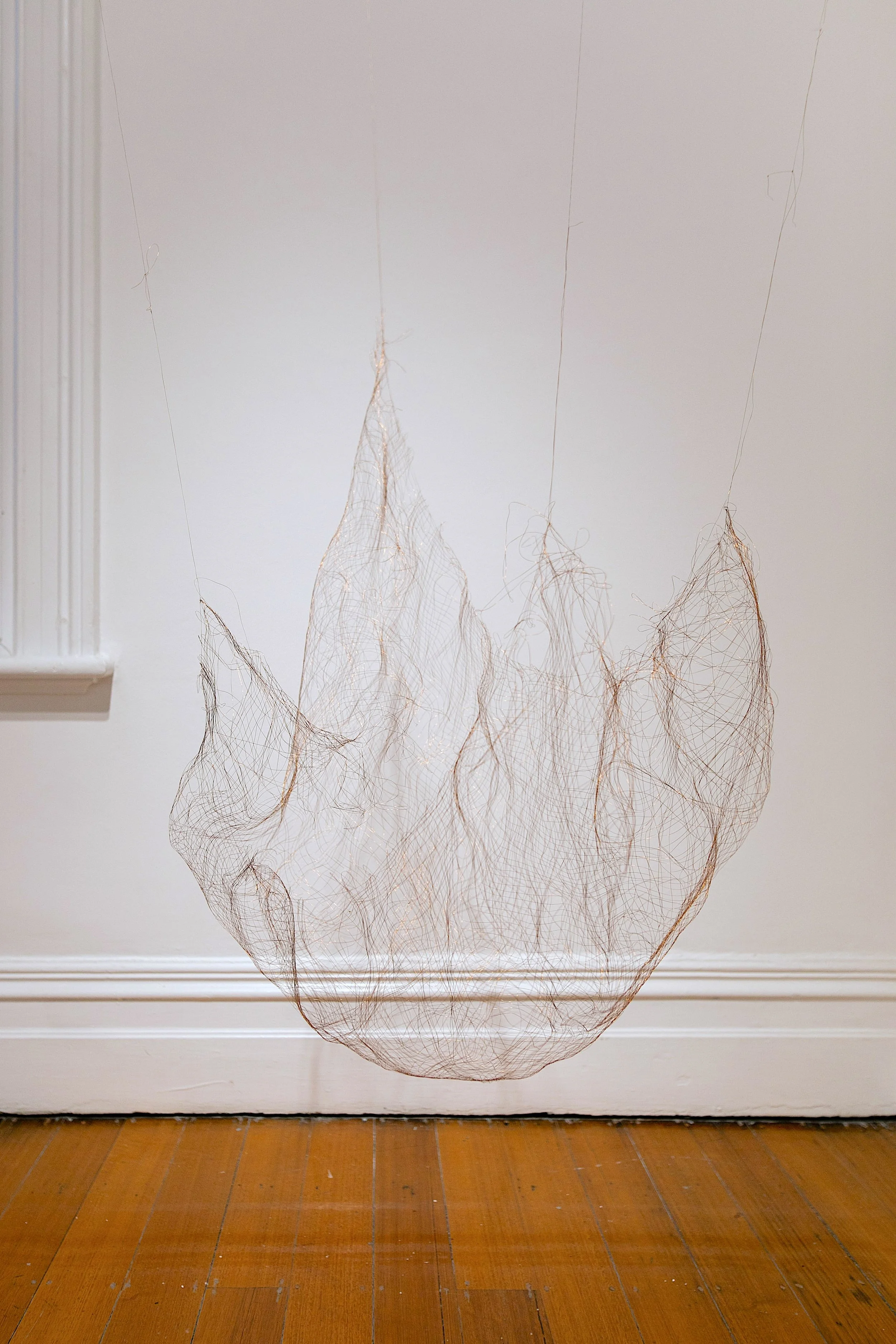
a spectral, a chronicle (i), 2025, Copper wire
Water always finds its way.
To tidelines.
from desire lines.
To birth
from death.
To now
from then.
Water always finds its way.
a spectral, a chronicle (i) is a fragile weaving from fine copper wire. The weaving takes the distant shape of a basket suspended from the ceiling.
The process of weaving was undertaken in watery sites of significance to the artist. The memory of Melukerdee Sea Country is gathered and woven in.
It is a spectral, a ghost, an echo both in form and filament. Designed to hold the unseen and unheard of indigenous place memory. It is a chronicle, a factual reading of time and story and it is a record of no time and all time. It is a conduit between us and place, between us and family.
This work is an extension of to collect with holes in your basket (i), 2023 which referenced the dispersion and attempted erasure of indigenous identity regathered and distilled in a hole(y) basket.
Sara Morawetz
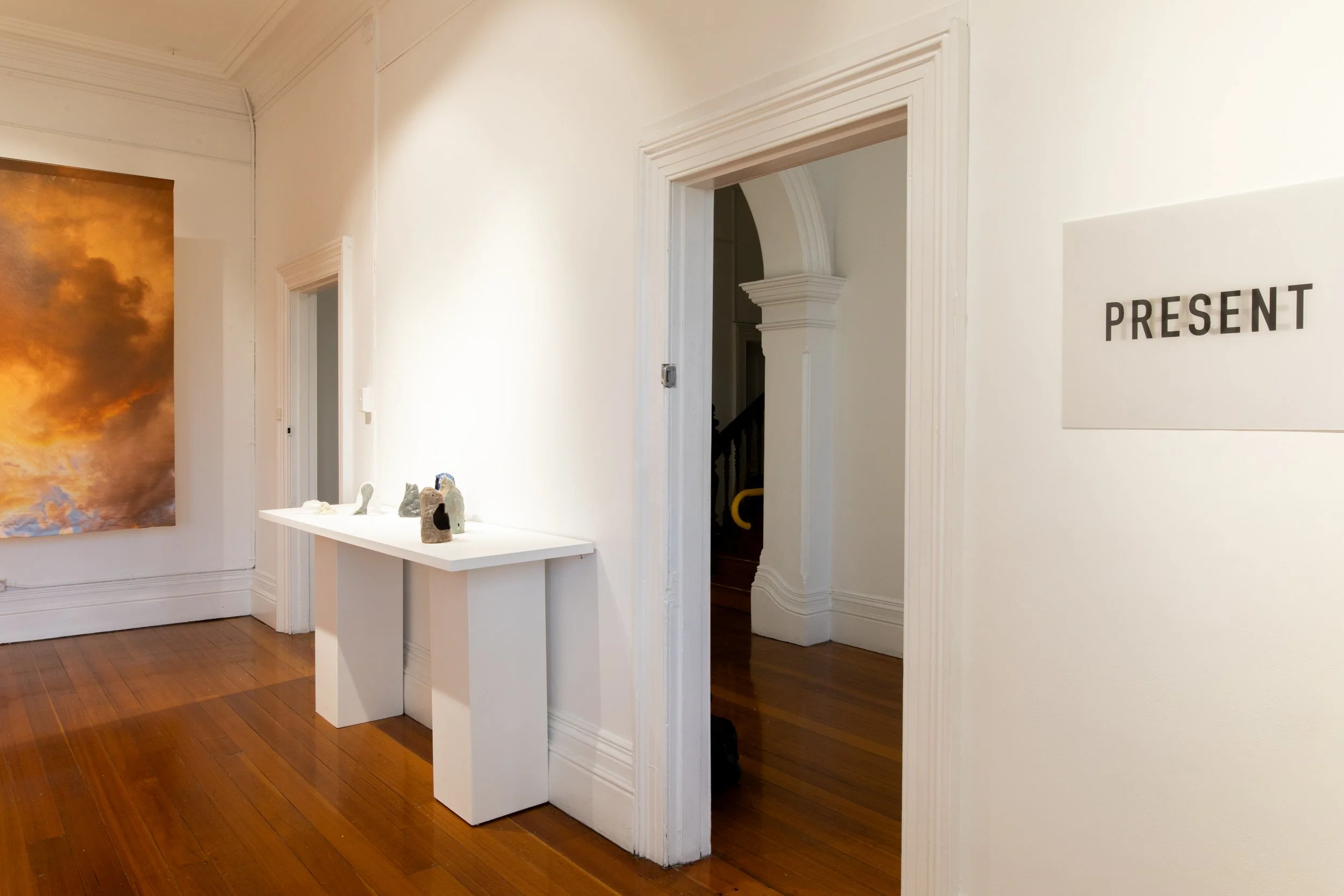
Tenses, 2017, lenticular prints
Tenses is a study of lexical ambiguity, conceived to test points of transition in time and space. Utilising the unique properties of lenticular printing and the viewer’s own dynamic movement, each print cycles through a set of linguistic tenses – showing (PAST//PRESENT//FUTURE), (YESTERDAY//TODAY//TOMORROW), (BEGINNING//MIDDLE//END) depending on the viewer’s position in relation to the work.
As the viewer moves the tenses move with them and in-between there is a ‘ghosting’ –– where one word overlaps another conveying the conceptual indeterminacy that is bound to such fixed states of being. Tenses asks us to question: When does the present become the past? When does today end and tomorrow begin? And what do we call that space in-between –– before one is determined as a consequence of the other?
Jodie Whalen
Stranger in Paradise, 2018, Digital image printed on fabric
Imagery of the physical world, objects, light, ocean and sky is replicated and distorted. Meaning moves through, and translates between forms, signifying time and transformation. Symbols of earthly experience and liminal space become metaphors for our understating and experience of the unknown, the physical and the metaphysical. Driven by a desire to give physical form to the intangibility of fraught emotional states such as grief, unrequited intimacy and hopefulness.
This project was assisted through Arts Tasmania by the Minister for the Arts through an Support for Groups grant.